

BFCM can create more traffic, more urgency, and more revenue than almost any other period in the ecommerce calendar.
It can also magnify pricing mistakes.
If your pre-sale price is too high, you may lose conversion before the promotion even begins. If it is too low, you may train shoppers to wait for a discount and give away margin you never needed to sacrifice.
That is why the smartest time to test price is not during BFCM itself.
It is in the weeks before the sale.
A strong BFCM campaign starts with understanding what customers are willing to pay before the discount goes live.
Why pre-BFCM pricing matters
Many Shopify brands plan BFCM around offers, bundles, and creative.
Those pieces matter, but the baseline price matters just as much.
Your starting price affects:
- Perceived value
- Discount depth
- Conversion rate
- Gross margin
- Profit per visitor
- How urgent the BFCM offer actually feels
If your baseline price is already weak, the sale can look bigger without making the business stronger.
For example, a product priced too low before BFCM may convert well, but it leaves little room for a profitable discount. A product priced slightly higher may keep conversion stable while giving you more flexibility to run an offer that still feels compelling.
The risk of guessing your sale setup
Too many stores build BFCM pricing around assumptions like these:
- “Our current price is probably fine.”
- “We can always discount harder if conversion drops.”
- “Customers only buy during BFCM when the markdown is big enough.”
These assumptions often lead to one of two outcomes:
| Scenario | What happens | Why it hurts |
|---|---|---|
| Baseline price is too low | The BFCM offer gets attention but margin disappears | Revenue rises while profit weakens |
| Baseline price is too high | The store depends on a heavy discount to convert | Shoppers learn to wait for sales |
Neither outcome is ideal.
The goal is to find a pre-sale price that supports both healthy everyday economics and a credible BFCM promotion.
What you should test before BFCM
Before the sale period begins, test a realistic range of prices on your product page.
The best candidates are usually:
- Best-selling products
- Products with stable inventory
- Products receiving paid or repeat traffic
- Products likely to feature in your BFCM campaign
- Products where margin matters most
You do not need to test every item in the catalog.
Start with the products most likely to drive seasonal revenue.
A simple pre-BFCM testing framework
The goal is not to run a complex research project.
The goal is to learn whether a slightly different baseline price creates a better balance between conversion and profit.
Use this framework:
- Choose one high-impact product.
- Define your minimum acceptable margin.
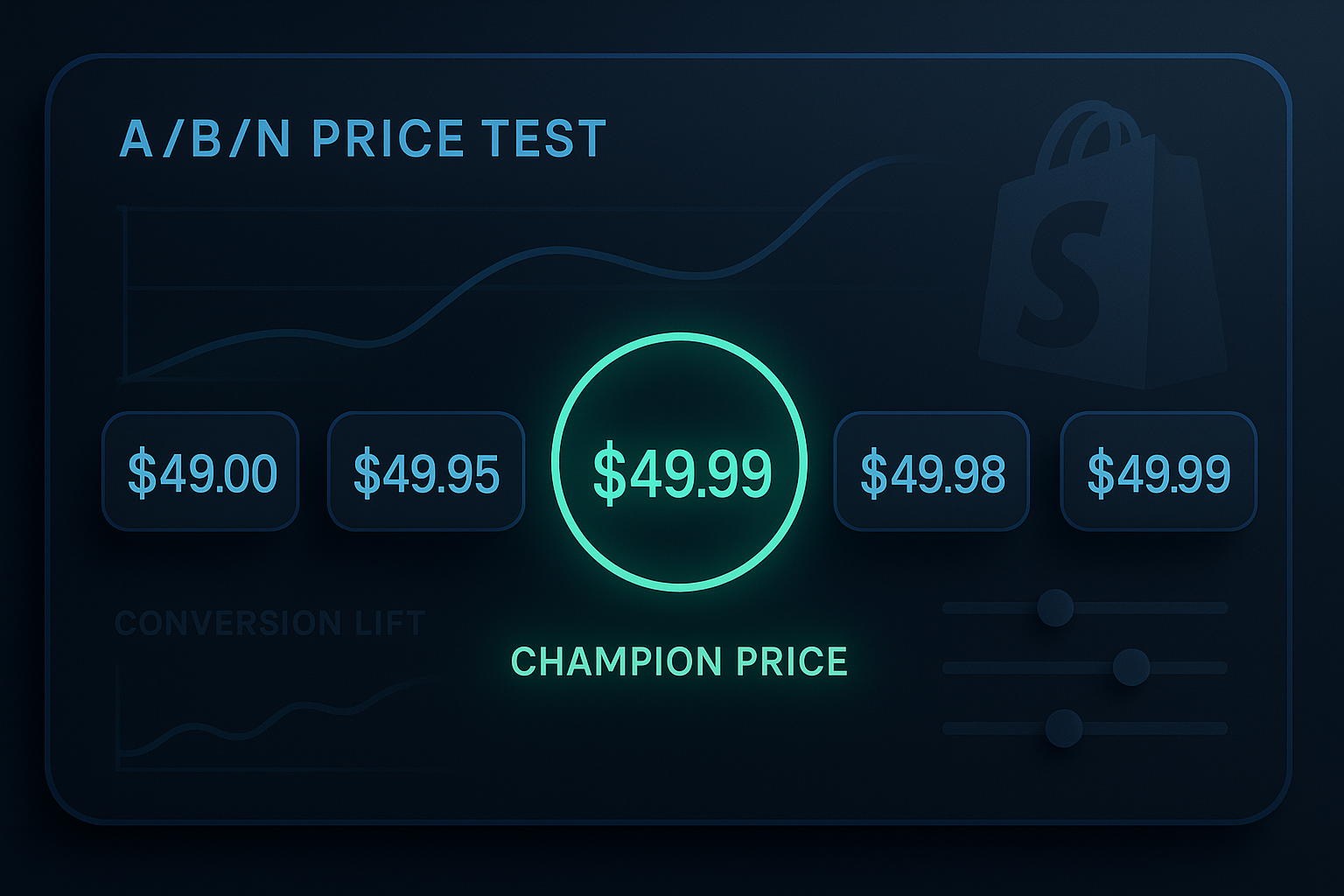
- Select 3–5 realistic price points.
- Run the test before your BFCM promotion starts.
- Measure conversion rate, revenue per visitor, and profit per visitor.
- Use the winner as the anchor for your BFCM discount strategy.
Example price range
If a product currently sells for $49, you might test:
- $47
- $49
- $52
- $55
This range is close enough to stay realistic and wide enough to reveal whether customers are sensitive to small price changes.
The metrics that matter most
During BFCM planning, revenue can become a distracting metric.
Revenue matters, but it should not be the only signal guiding a pricing decision.
Track these metrics together:
| Metric | Why it matters |
|---|---|
| Conversion rate | Shows how each price affects purchase intent |
| Average order value | Helps you understand order quality |
| Revenue per visitor | Reveals how much each visitor is worth |
| Profit per order | Protects margin at the transaction level |
| Profit per visitor | Combines demand and margin into one decision metric |
For most BFCM preparation, profit per visitor is the strongest primary metric.
It helps answer the real question: which price gives the business the healthiest return from traffic before the sale starts?
How pre-sale testing improves your BFCM offer
Once you understand your strongest baseline price, your BFCM strategy becomes much clearer.
You can make better decisions about:
- How deep the discount should be
- Whether to use a percentage discount or a fixed amount
- Which products can support aggressive offers
- Which products should use bundles or shipping incentives instead
- How to protect margin without weakening the campaign
Example: two different outcomes
Imagine your current price is $50.
After testing, you discover that $54 converts almost as well but produces better profit per visitor.
That insight changes the BFCM setup:
| Option | Baseline price | BFCM discount | Sale price | Strategic effect |
|---|---|---|---|---|
| No test | $50 | 20% off | $40 | Familiar offer, thinner margin |
| Tested baseline | $54 | 15% off | $45.90 | Stronger starting margin, credible discount |
The tested version may create a healthier balance between conversion and profit, even if the discount percentage looks smaller.
That is the point of pre-BFCM optimization.
You are not trying to create the biggest markdown.
You are trying to create the smartest offer.
Common mistakes to avoid
Pre-BFCM price testing usually breaks down when brands:
- Start testing too late
- Test too many products at once
- Choose unrealistic price jumps
- Judge results only by orders or revenue
- Change the page, creative, and price at the same time
- Ignore stock, shipping, or fulfillment constraints
Keep the experiment focused.
The more variables you change at once, the harder it becomes to trust the result.
When to start
Ideally, price testing should happen early enough that you can still act on the result before your BFCM campaign is locked.
That gives you time to:
- Update merchandising plans
- Adjust promotional messaging
- Align discount depth with margin goals
- Decide which products deserve the most traffic
If you wait until BFCM week, you are no longer optimizing.
You are reacting.
Final takeaway
BFCM rewards stores that prepare with data, not guesswork.
The brands that perform best are not always the ones with the biggest discounts. They are often the ones that understand their price ceiling, their margin guardrails, and the offer structure that customers respond to most.
Test your baseline price before the sale.
Then build your BFCM promotion on top of real evidence instead of assumptions.
Pricision
Stop guessing your next price
Use real customer behavior to discover the price that generates the strongest result for your Shopify store.
Start your free trial