

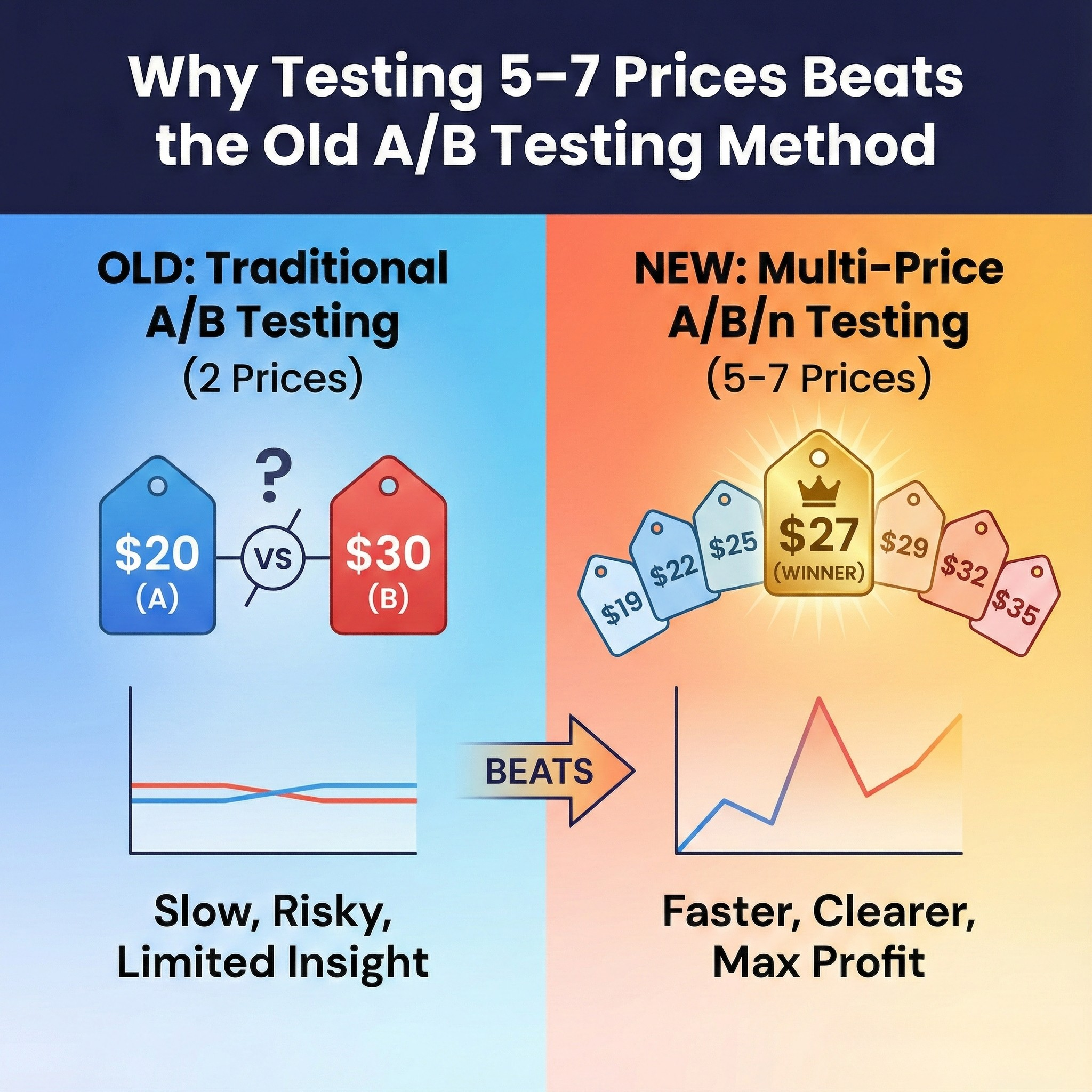
Traditional A/B testing compares two possibilities.
For landing pages, headlines, and button colors, that may be enough. But when the variable is price, comparing only two options can leave a large part of the opportunity unexplored.
A price test between $19.99 and $29.99 can tell you which of those two performs better. It cannot tell you whether the real winner is $23.99, $25.99, or $27.99.
That is why modern ecommerce brands are moving toward A/B/n price testing.
Two prices reveal a preference. Multiple prices reveal the shape of customer demand.
Why traditional A/B price testing is limited
A standard A/B test forces a business to choose two price points before collecting any customer data.
One group of visitors sees price A. Another group sees price B. The business then compares the results.
This approach is simple, but it creates an important problem: the winning price may not be included in the experiment.
Imagine testing these two prices:
- $19.99
- $29.99
The test may show that $29.99 generates more profit. However, that does not prove that $29.99 is the optimal price.
A price such as $25.99 or $27.99 might convert almost as well while producing a better balance between order volume and margin.
Traditional A/B testing only identifies the better of two selected options. It does not necessarily identify the best price available.
What A/B/n price testing changes
A/B/n testing compares more than two variations within the same experiment.
Instead of testing only price A and price B, a brand can test several realistic price points:
| Variation | Price |
|---|---|
| A | $19.99 |
| B | $21.99 |
| C | $23.99 |
| D | $25.99 |
| E | $27.99 |
| F | $29.99 |
Each variation receives a portion of the available traffic.
The system then compares how every price performs across metrics such as:
- Conversion rate
- Revenue per visitor
- Profit per visitor
- Average order value
- Total orders
- Total profit
This gives the business a much clearer picture of how customers react across an entire price range.
Why testing 5–7 prices can produce better insights
Testing multiple prices does more than add extra variations. It changes the quality of the information the experiment provides.
1. You can discover an unexpected sweet spot
The most profitable price is often not one of the obvious choices.
A business might assume that customers will only accept either a low price or the current price. In reality, a small increase may have little effect on conversion while producing a meaningful improvement in profit.
Suppose a product currently sells for $24.99.
A traditional test might compare:
- $24.99
- $29.99
But the strongest result may come from $27.99.
A two-price experiment would never reveal that result.
2. You see the relationship between price and demand
Multiple variations help show how customer behavior changes as price increases.
You may discover that:
- Conversion remains stable across the first four prices
- Conversion drops sharply above a certain threshold
- Revenue continues increasing despite fewer orders
- Profit per visitor peaks before conversion starts falling significantly
This creates a more complete view of price sensitivity.
Instead of knowing that one price beat another, you begin to understand where customer resistance actually starts.
3. You reduce the need for repeated experiments
A traditional sequence of tests may look like this:
- Test $19.99 against $22.99
- Test the winner against $24.99
- Test the next winner against $26.99
- Test again against $28.99
Each experiment requires traffic, time, monitoring, and analysis.
A well-designed A/B/n test can evaluate these variations within one coordinated experiment.
This does not mean every business should test as many prices as possible. It means that when traffic supports it, testing a realistic range can reduce the number of separate experiments required.
More variations do not automatically mean faster results
It is important to avoid a common misunderstanding.
Testing more prices does not automatically create more statistical confidence. Each variation receives a smaller portion of the available traffic.
For example:
- In an A/B test, each variation may receive around 50% of traffic
- In a five-price test, each variation may receive around 20%
- In a seven-price test, each variation may receive around 14%
Because each price receives fewer visitors, a multi-price test may require more total traffic than a simple A/B test.
The benefit is not that every variation reaches confidence faster. The benefit is that the business can evaluate a broader price landscape within one experiment.
Multi-price testing is most useful when the product has enough traffic to support several meaningful variations.
How to choose the right number of prices
Five to seven prices can work well for products with consistent traffic, but the exact number should depend on the situation.
Consider:
- Daily product-page traffic
- Current conversion rate
- Average order value
- Margin range
- Expected test duration
- Difference between price variations
A lower-traffic product may be better suited to three or four variations.
A high-traffic product may support seven or more.
The goal is not to maximize the number of prices. The goal is to test enough realistic variations to find useful differences without spreading traffic too thinly.
How to select your price range
A good price test should explore realistic possibilities.
Start with three decisions.
Define the minimum price
Your minimum should respect:
- Product cost
- Fulfillment cost
- Advertising cost
- Transaction fees
- Target margin
A low price that increases conversion but destroys profit is not a meaningful winner.
Define the maximum price
Your maximum should still make sense for:
- Product positioning
- Perceived value
- Competitor context
- Customer expectations
- Brand strength
The purpose is to explore customer willingness to pay, not to create unrealistic variations.
Choose the step between prices
The step controls how closely the variations are spaced.
For example:
Minimum price: $19.99
Maximum price: $29.99
Step: $2