

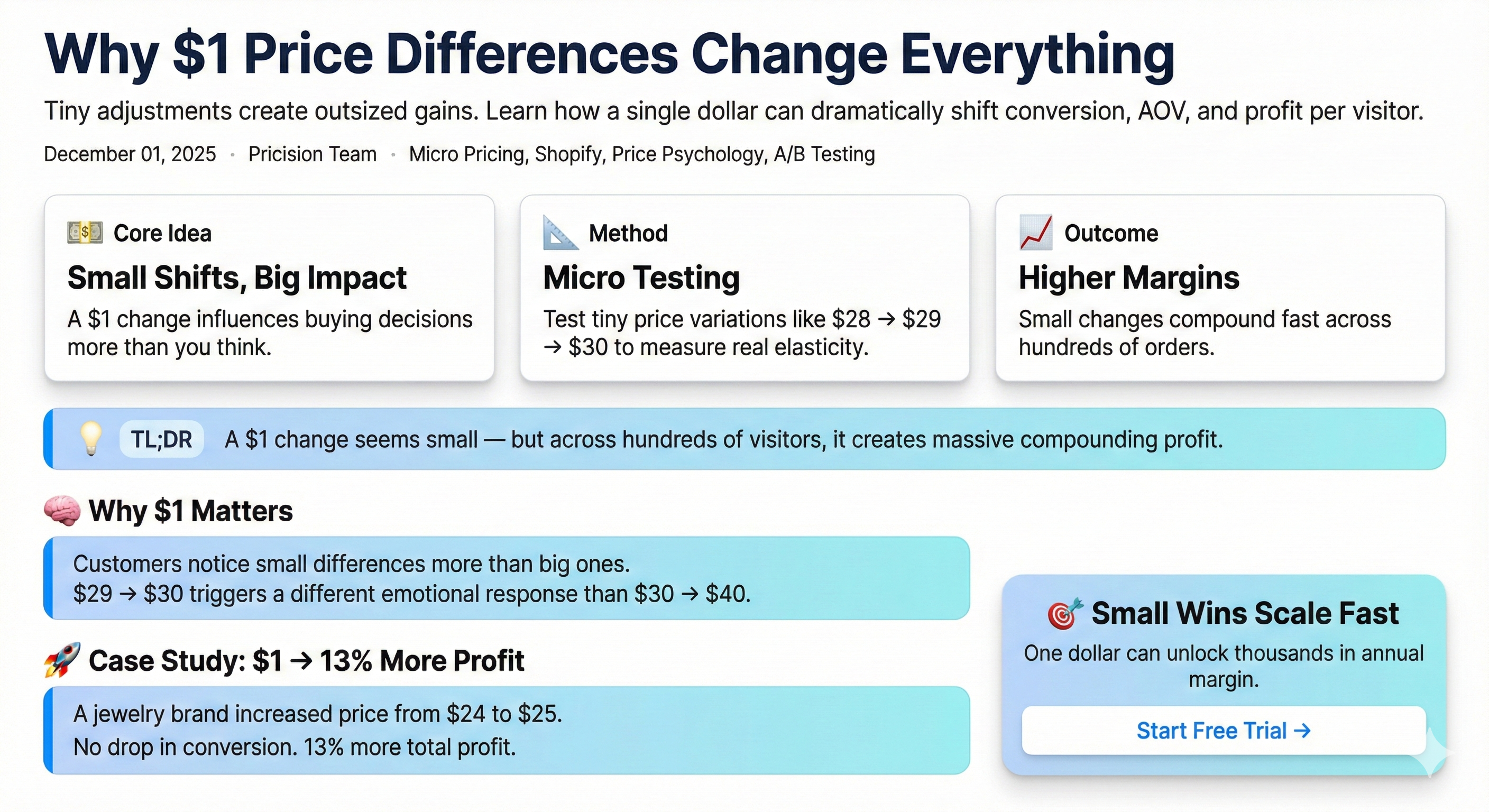
A one-dollar price change looks small on paper.
On a live Shopify store, it can change everything.
That is because buyers do not react to price in a purely mathematical way. They react to what the price feels like, how it compares to alternatives, and whether it still feels safe to buy.
Small price changes often reveal big differences in conversion, AOV, and profit per visitor.
Why $1 matters so much
A single dollar can shift:
- Perceived affordability
- Confidence in the offer
- Cart abandonment rates
- Revenue per order
- Total profit across traffic
The effect becomes even bigger when the product gets thousands of visits per month.
A $1 lift across enough orders can create a meaningful profit increase without requiring more traffic.
The psychology behind small price differences
Price perception is sensitive to small changes.
A product priced at $28 can feel different from one priced at $29, even though the actual gap is tiny.
That is because shoppers do not evaluate price in isolation.
They compare the price to:
- The product’s value
- Competitor prices
- Their expected budget
- The emotional cost of buying
When you test small increments, you can find the exact point where those perceptions shift.
The three metrics that change most
1. Conversion rate
A higher price may reduce conversion slightly.
That is not automatically bad if the price increase more than makes up for the drop.
2. Average order value
Even a $1 increase can lift the amount earned from every order.
Across large order volumes, that lift compounds quickly.
3. Profit per visitor
This is the metric that matters most.
A price that converts a little less can still be the winner if the profit gain is stronger than the conversion loss.
How to test $1 differences the right way
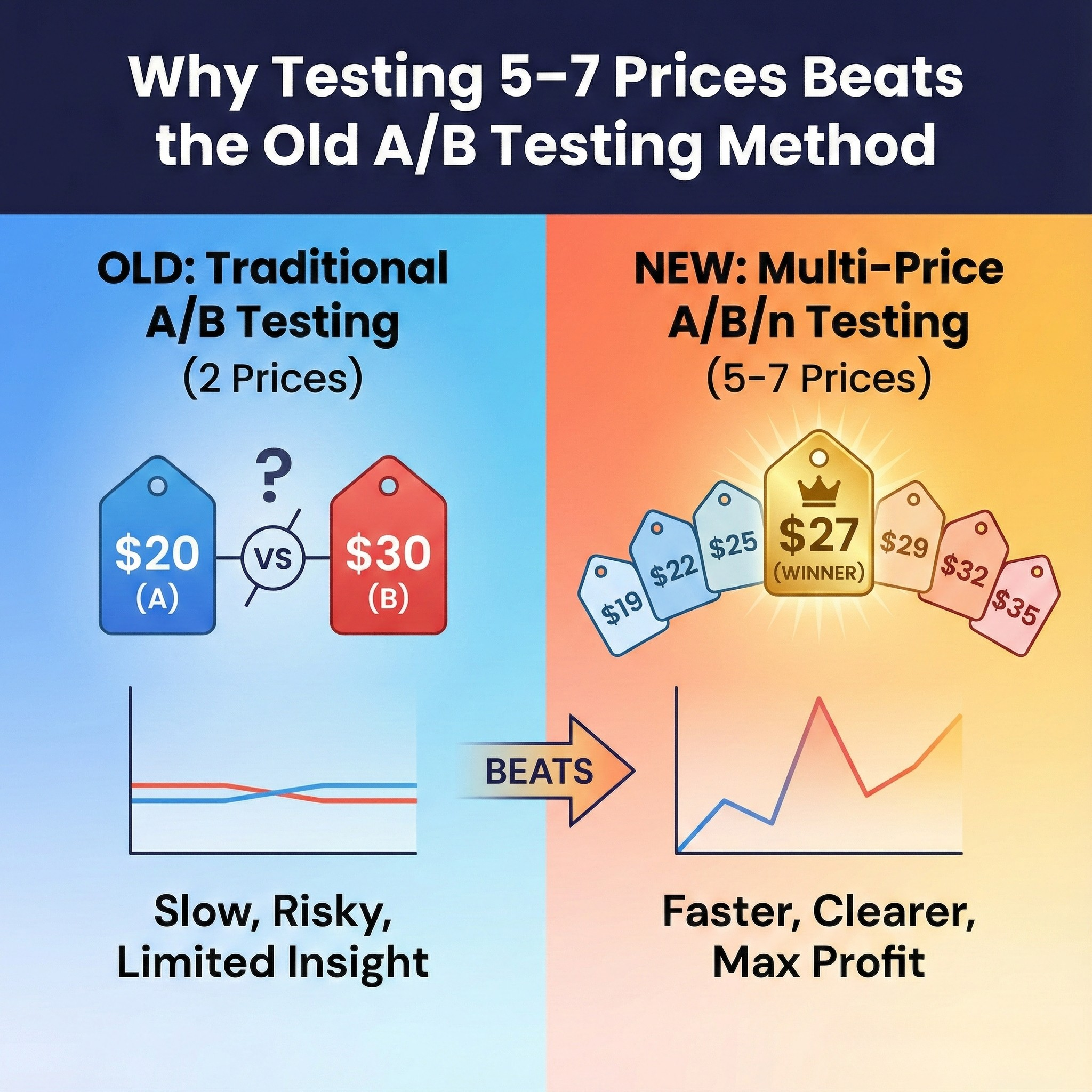
Use a structured A/B/n test:
- Pick one high-selling product.
- Create small price steps like $24, $25, and $26.
- Let traffic split evenly across variations.
- Run the test for 7 to 10 days.
- Compare profit per visitor, not just conversion.
The winning price is often only one or two dollars away from your current baseline.
Example: $24 vs $25
A jewelry brand tested a product at $24 and $25.
The $25 version did not create a major conversion collapse.
Instead, it produced:
- Similar conversion rate
- Higher average order value
- 13% more profit per visitor
That one-dollar change became a real growth lever.
Common mistakes
Micro price testing fails when teams:
- Change too many page elements at once
- Test only one variation
- End the experiment too early
- Judge success by revenue alone
- Skip margin checks
If you want to learn from $1 differences, the rest of the experiment has to stay clean.
Final takeaway
The smartest price change is not always the biggest one.
Sometimes the next profit jump is hiding inside a single dollar.
If you test small increments carefully, you can uncover the price that customers accept and the one that grows profit the most.
Pricision
Stop guessing your next price
Use real customer behavior to discover the price that generates the strongest result for your Shopify store.
Start your free trial