

A full Shopify redesign can feel like the obvious answer when a store is underperforming.
New branding. Better product pages. Cleaner navigation. Improved mobile layouts. A more modern checkout experience.
These changes may be valuable, but they often require weeks of planning, design, development, testing, and review before the business learns whether performance actually improved.
Price testing takes a different approach.
Instead of rebuilding the entire storefront, a brand can test several realistic price points and measure how each one affects conversion, revenue, and profit.
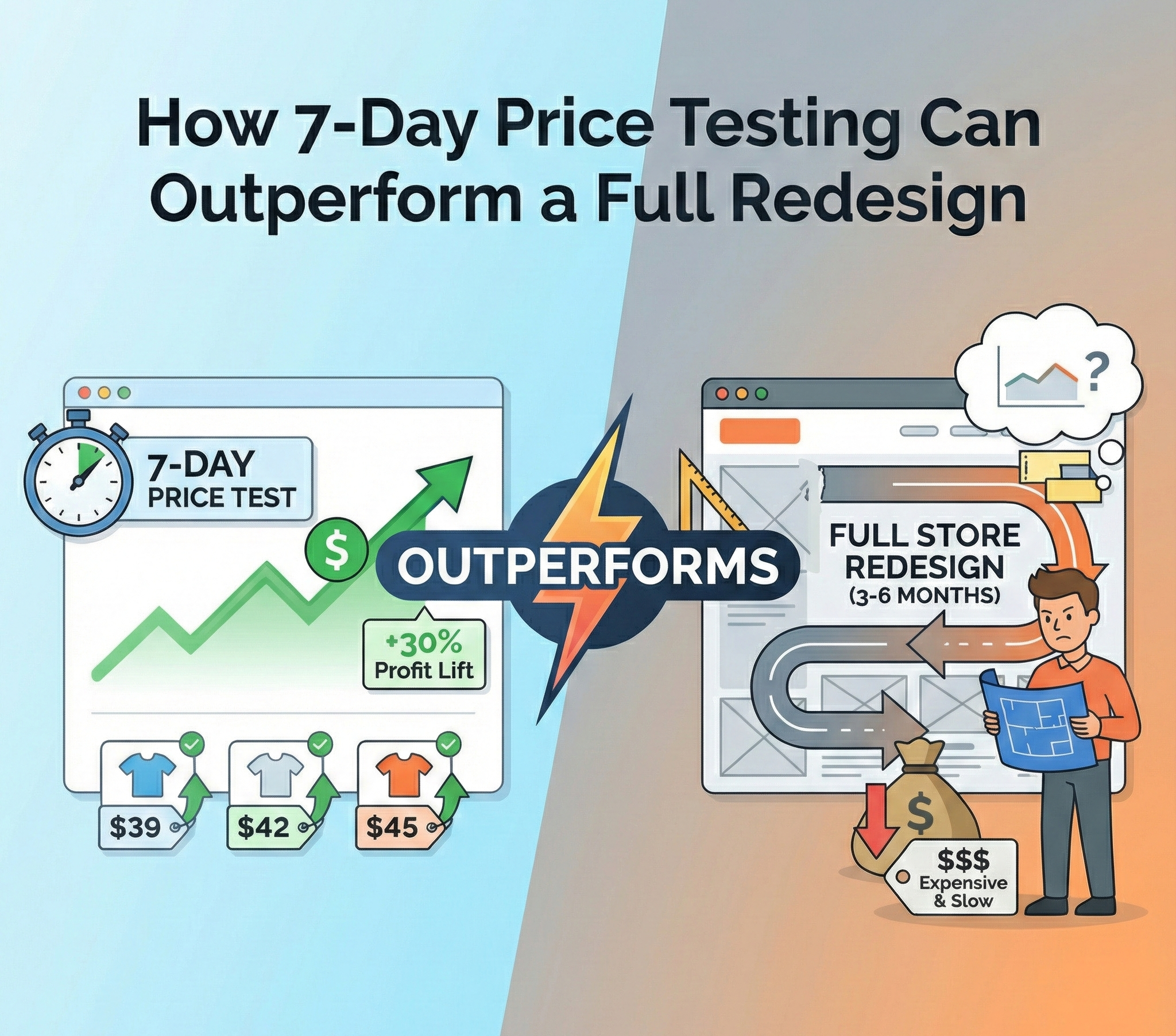
In the right conditions, a focused seven-day price experiment can reveal a meaningful profit opportunity before a redesign even reaches development.
A redesign changes how customers experience the store. A price test measures how customers value the product.
The two strategies solve different problems, but pricing is often the faster lever to validate first.
Why redesigns are attractive
Redesigns create visible change.
A new store looks different immediately, which makes the project feel substantial and strategic.
A redesign can improve:
- Brand presentation
- Mobile usability
- Navigation
- Page speed
- Product discovery
- Checkout clarity
- Trust and credibility
- Content hierarchy
These improvements matter when the existing store has genuine usability or positioning problems.
The challenge is that a redesign does not guarantee better business performance.
A more attractive product page may still struggle if:
- The offer is weak
- Traffic quality is poor
- The product lacks demand
- Shipping costs create friction
- Customers do not trust the brand
- The price is misaligned with perceived value
Design can improve the presentation of an offer. It cannot automatically make the offer more profitable.
The hidden cost of a full redesign
A redesign requires more than design work.
A typical project may involve:
- Research
- Customer interviews
- Competitive analysis
- Wireframes
- Visual design
- Copywriting
- Development
- Quality assurance
- Analytics setup
- Migration
- Launch monitoring
Even a relatively focused redesign can take several weeks.
A larger project may require months.
During that time, the business pays for the work before knowing whether the new experience will improve conversion or profitability.
The final outcome may also be difficult to measure if several elements change simultaneously.
When a store changes its layout, copy, images, navigation, offers, and product presentation at the same time, it becomes difficult to identify which change caused the result.
Why pricing is a high-leverage variable
Price affects every visitor who evaluates the product.
It directly influences:
- Perceived value
- Purchase hesitation
- Conversion rate
- Revenue per order
- Gross margin
- Profit per visitor
A small price change can affect both demand and margin.
This makes pricing one of the most powerful variables in ecommerce.
Consider a product selling for $40.
If the price increases to $43 while conversion remains nearly stable, the business earns more revenue from approximately the same traffic.
If the price decreases to $37 and conversion rises significantly, the lower price may produce more total profit.
The correct answer cannot be known from intuition alone.
It must be tested.
What a seven-day price test can reveal
A seven-day test can provide an early view of how customers respond across several price points.
For example, a brand might test:
- $39
- $42
- $45
Each variation receives a portion of product traffic.
The business then compares:
- Conversion rate
- Revenue per visitor
- Profit per visitor
- Number of orders
- Total revenue
- Total profit
A short test may not always produce final statistical certainty, especially for lower-traffic products.
However, it can quickly reveal whether pricing is likely to be a meaningful opportunity.
Seven days is a useful testing window only when the product receives enough qualified traffic and conversions.
The real requirement is not the number of days.
It is the amount and quality of data collected during the experiment.
Price testing versus redesigning
The two approaches differ in cost, speed, and scope.
| Factor | Price test | Full redesign |
|---|---|---|
| Time to launch | Hours or days | Several weeks or months |
| Development work | Minimal | Significant |
| Primary variable | Price | Multiple design and UX elements |
| Measurement clarity | High when isolated | Lower when many elements change |
| Upfront cost | Relatively low | Often substantial |
| Revenue during project | Test runs on live traffic | Benefits usually begin after launch |
| Main objective | Improve pricing economics | Improve experience and presentation |
A price test is not a replacement for every redesign.
It is a faster experiment that can determine whether pricing deserves attention before a larger investment begins.
The seven-day testing framework
A focused price experiment can follow a simple process.
Day 1: Select the right product
Choose a product with enough traffic to produce useful results.
Good candidates include:
- Best-selling products
- Products receiving paid traffic
- Products with stable inventory
- Products with strong margins
- Products frequently discounted
- Products with uncertain pricing
Avoid products with very low traffic or inconsistent stock.
A product that generates only a few visits per day is unlikely to provide enough evidence within one week.
Day 1: Define the objective
Choose the primary metric before the test starts.
Possible objectives include:
- Maximize conversion rate
- Maximize revenue per visitor
- Maximize profit per visitor
- Validate a price increase
- Reduce discount dependency
- Identify an acceptable launch price
For most profit-focused pricing experiments, profit per visitor is the strongest primary metric.
Profit per visitor =
Total profit ÷ Total visitors