


Most ecommerce brands do not have a pricing system.
They have prices.
A product launches, the team reviews the margin, checks a few competitors, chooses a number that feels reasonable, and moves on.
That price may remain unchanged for months, even while customer behavior, advertising costs, product demand, and competitor positioning continue to shift.
The problem is not that the original price was necessarily wrong.
The problem is that there is no repeatable process for determining whether it is still right.
Winning brands do not search for one perfect price. They build a system that continuously improves pricing decisions.
A mature pricing system replaces one-time decisions with structured experimentation, measurement, and optimization.
The problem with set-and-forget pricing
Static pricing assumes that the market remains stable.
In reality, ecommerce conditions change constantly.
A product may perform differently because of:
- Rising advertising costs
- New competitors
- Seasonal demand
- Changes in customer acquisition channels
- Stronger brand recognition
- New customer segments
- Product reviews and social proof
- Inventory availability
- Shipping costs
- Changes in perceived value
A price that performed well six months ago may no longer produce the strongest result today.
Yet many Shopify brands only revisit pricing when something goes wrong.
They lower prices when conversion declines, launch discounts when sales slow, or copy a competitor after seeing a lower offer.
This is reactive pricing.
It may solve a short-term problem, but it does not create a reliable growth system.
The three stages of pricing maturity
Most ecommerce brands move through three broad stages as their pricing process becomes more sophisticated.
Stage 1: Reactive pricing
Reactive pricing is driven by immediate pressure.
The team changes prices because:
- Sales have slowed
- Competitors reduced their prices
- Advertising has become more expensive
- Inventory is not moving
- A campaign is underperforming
- A stakeholder believes the product is too expensive
The decision is usually based on intuition, urgency, or external signals.
This stage is fast, but fragile.
There is rarely a documented process, a clear success metric, or enough evidence to know whether the change improved profitability.
What reactive pricing looks like
A reactive pricing workflow often looks like this:
- Performance declines
- The team assumes price is the problem
- A discount or price reduction is launched
- Conversion changes
- The result is judged using revenue or order count
- The new price remains in place
Several important questions remain unanswered:
- Did profit per visitor improve?
- Was the original price actually the problem?
- Would a higher price have performed better?
- Did the discount attract lower-value customers?
- Was the result caused by price or another page change?
Without structured testing, the brand cannot separate evidence from assumption.
Stage 2: Data-driven testing
The second stage begins when the team stops treating pricing as a fixed decision.
Instead, pricing becomes a hypothesis to test.
The brand starts comparing multiple price points and measuring how each variation affects:
- Conversion rate
- Revenue per visitor
- Profit per visitor
- Average order value
- Gross margin
- Total profit
This stage introduces discipline.
Price changes are no longer made only because someone feels that the product is too expensive or too cheap.
They are validated using real customer behavior.
From opinions to hypotheses
A strong pricing hypothesis should be specific.
Instead of saying:
We think the price is too high.
The team might say:
We believe increasing the product price from $49.99 to a range between $52.99 and $57.99 will increase profit per visitor without causing an unacceptable decline in conversion.
This creates a measurable question.
The result can then be evaluated using data rather than internal preference.
Stage 3: Systemized optimization
The third stage is reached when pricing experiments become part of a repeatable operating system.
The brand no longer runs occasional tests only when performance declines.
Instead, it creates a continuous loop:
- Identify an opportunity
- Define the test objective
- Select realistic price variations
- Run the experiment
- Measure the business result
- Apply the winner
- Monitor performance
- Test again when conditions change
This is systemized pricing.
The process is documented, repeatable, and connected to business goals.
Automation helps reduce manual work, but the real advantage is consistency.
The brand no longer depends on memory, instinct, or one individual making every decision.
The three pillars of a pricing system
A strong pricing system is built on three foundations:
- Structure
- Insights
- Automation
1. Structure
Structure defines how pricing decisions are made.
Without structure, every test becomes a separate project.
A structured pricing process should define:
- Who owns pricing decisions
- Which products should be tested first
- How price ranges are selected
- Which metrics determine the winner
- How long tests should run
- When a test should be stopped
- How winning prices are applied
- How results are documented
- When products should be retested
This creates consistency across the business.
Define ownership
Pricing often sits between several teams:
- Ecommerce
- Marketing
- Finance
- Merchandising
- Product
- Growth
Without clear ownership, decisions can become slow or contradictory.
One team may want higher conversion, while another prioritizes margin. A third may want to match competitors.
A mature system defines:
- Who proposes the test
- Who approves the price range
- Who reviews the results
- Who applies the winner
- Who monitors the long-term outcome
Define product priority
Not every product needs to be tested at once.
A brand can prioritize products using factors such as:
- High traffic
- High revenue
- Strong margins
- Stable inventory
- Strategic importance
- Uncertain pricing
- High advertising spend
- Discount dependency
Testing high-impact products first usually creates the fastest business value.
2. Insights
A pricing system needs more than data.
It needs the right data.
Many brands track revenue and conversion but still lack the insight required to make profitable pricing decisions.
The goal is to connect price variations to business outcomes.
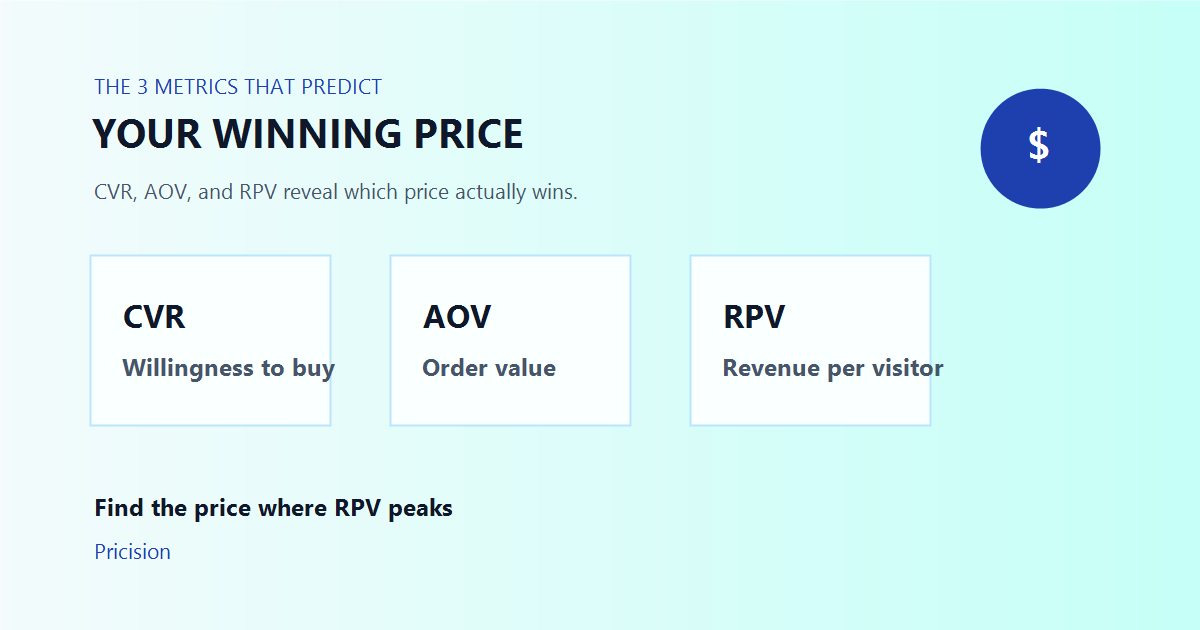
Conversion rate
Conversion rate shows how often visitors purchase.
It is useful, but incomplete.
A lower price may convert better while generating less profit.
Revenue per visitor
Revenue per visitor measures how much revenue the business generates from each visitor.
Revenue per visitor =
Total revenue ÷ Total visitors